
Every day, air transport moves more than 140,000 tonnes of goods around the world, and this cargo often travels on a ULD (Unit Load Device): equipment designed to fit the aircraft fuselage and lock into its loading system, making ground operations faster and flights safer.
Without ULDs, modern air cargo simply would not exist, which is why understanding them is useful not only for industry professionals but also for shippers. In this guide by Savino Del Bene, we explain what a ULD is, how it works, the most common ULD types, how to read ULD codes and how to choose the right one.
ULD meaning: what is a unit load device and what is it used for
The acronym ULD stands for “Unit Load Device”, the standard unit load used in air freight. According to the IATA definition, it is a device used to group and restrain cargo, mail and baggage for air transport: it can be either an aircraft container or an aircraft pallet combined with a restraint net.
At its core is the concept of the unit load, common to all logistics: several packages combined into a single entity that can be handled, stored and transported as one item, like a pallet on a truck or an ocean container. This load unitization reduces handling, speeds up operations and limits the risk of damage or loss.
In air transport, however, the aircraft ULD has a distinctive feature: it locks into the aircraft’s Cargo Loading System (CLS), the system of rollers, guides and locks that secures it to the floor, and during flight it effectively becomes part of the aircraft structure. This is why it is considered an aircraft component in every respect, subject to the airworthiness requirements of authorities such as the FAA and EASA and to the operational standards of the IATA ULD Regulations (ULDR).
A ULD performs four main functions:
- Operational speed: cargo is consolidated in the warehouse before the flight, reducing loading and unloading times at the aircraft and making transfers between flights easier;
- Protection: containers and pallets reduce the risk of damage, theft and loss;
- Space optimization: the contoured profile makes the most of the available hold volume;
- Flight safety: it prevents cargo from shifting during take-off, landing and turbulence, preserving the aircraft’s balance.
How ULDs work: build-up, loading and safety
ULD operations follow a precise process that begins well before departure and involves several parties: the airline, the airport handler, the freight forwarder and, in some cases, the shipper.
Choosing the ULD. Everything starts with selecting the right unit based on the aircraft type, the loading position (main deck or lower deck) and the characteristics of the cargo. A ULD that is perfect for a wide-body passenger aircraft may not be compatible with a freighter or a narrow-body aircraft.
Checking the empty ULD. Before build-up, the unit undergoes a serviceability check. Structure, panels, rails, doors and nets are inspected against the permitted damage limits set out in the ODLN (Operational Damage Limits Notice). A damaged ULD cannot fly.
Build-up. This is the stage in which cargo is assembled on the ULD. It takes place in the warehouse and is considered, in every respect, a pre-loading stage for the aircraft. The basic rules are: heavier packages at the bottom and lighter ones on top, packages interlocked to prevent shifting, weight evenly distributed and strict compliance with the contour required for the position on board. When the ULD is built up by the freight forwarder rather than the airline’s handler, it is known as a BUP (Built-Up Pallet/Unit).
Securing the load. On pallets, cargo is restrained with certified nets and, where needed, additional straps. Containers are closed with doors or curtains. Depending on the goods, protective film, corner protectors, thermal covers or security seals are added.
Final checks. The ULD is weighed, measured and labeled. Operators verify that it does not exceed the maximum gross weight (MGW) and that its profile stays within the contour. This data feeds into the flight documentation and the load plan.
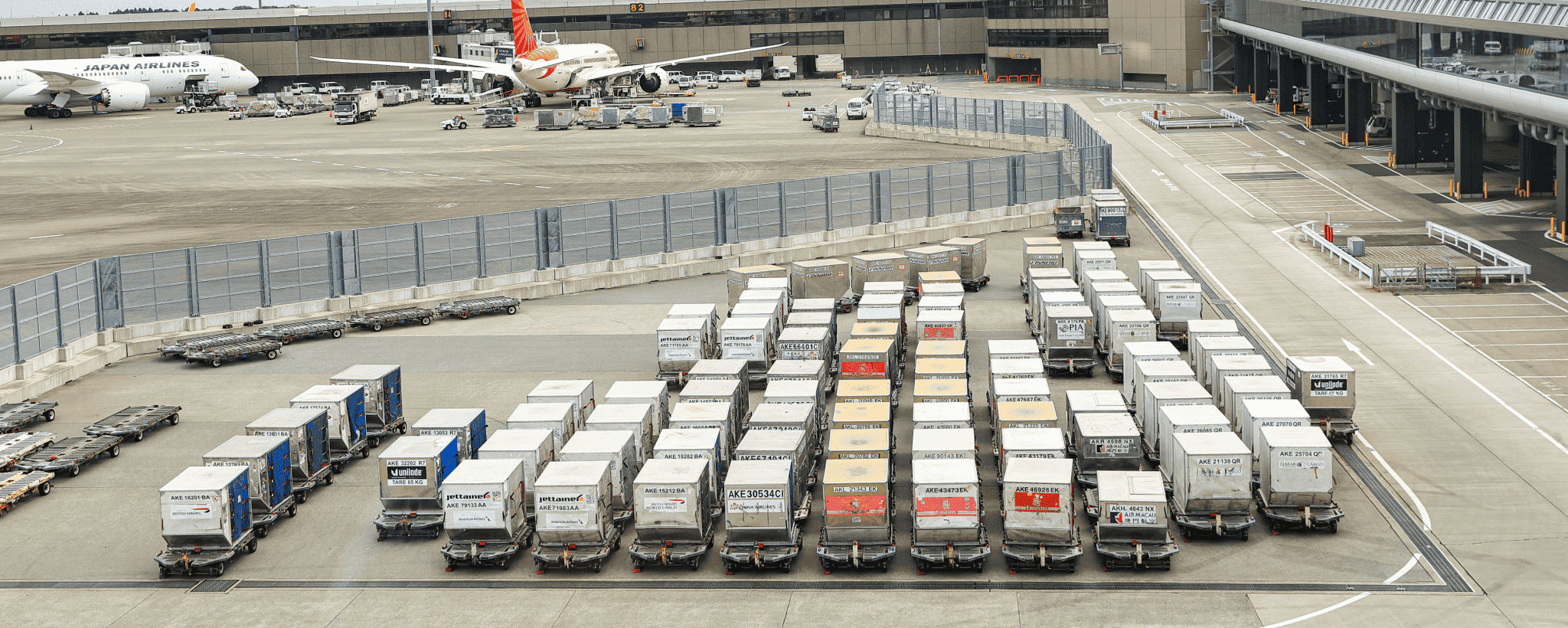
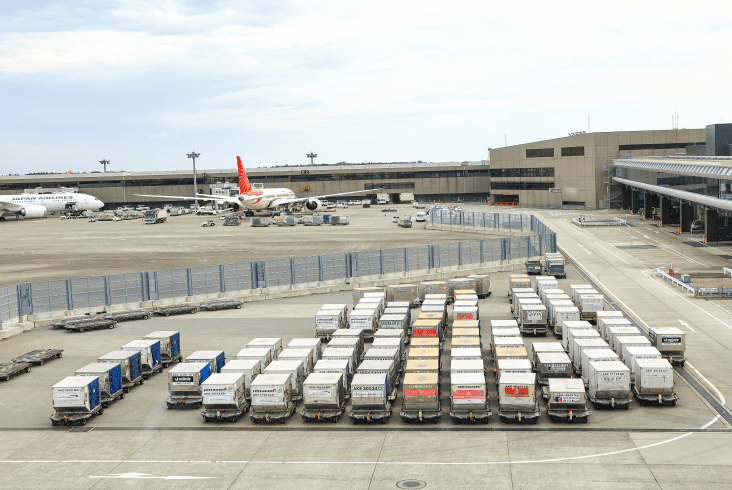
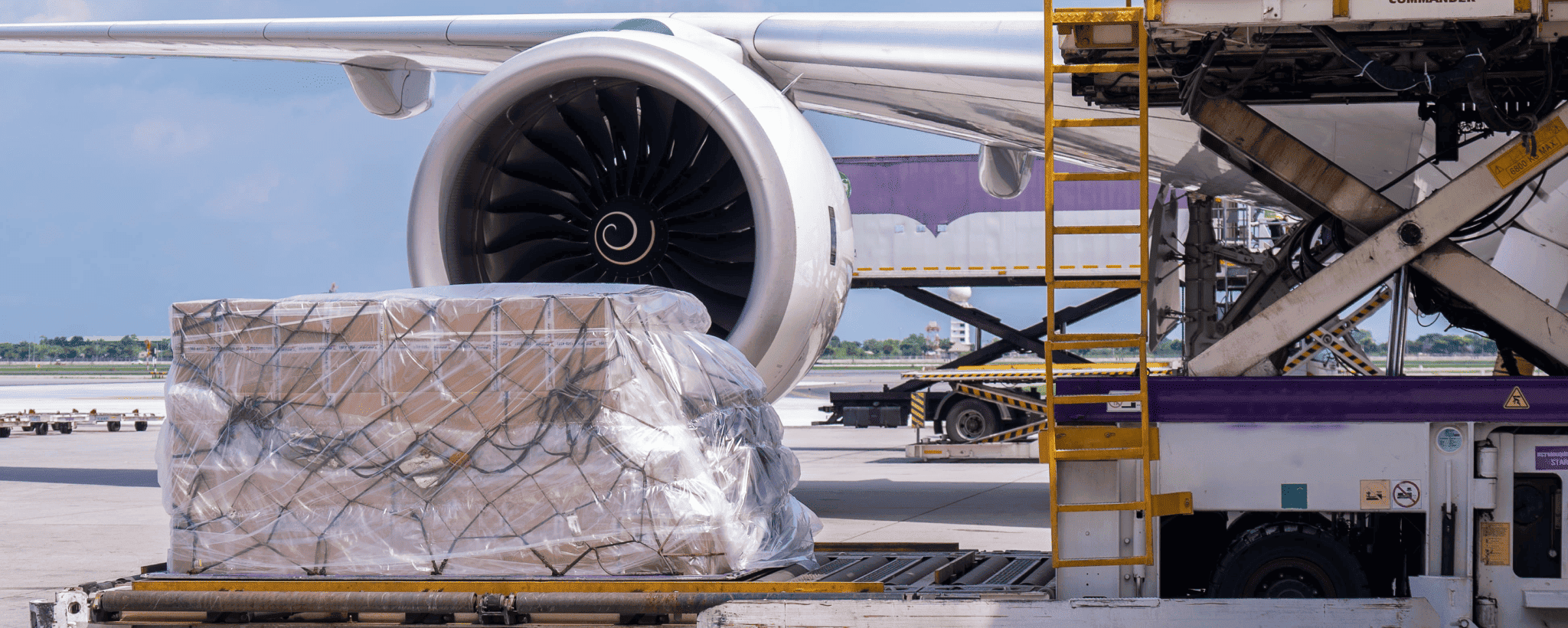
Airside transfer and loading. The ULD is taken to the aircraft on dollies towed by airport tractors, then lifted with dedicated loaders and rolled into the hold on the Cargo Loading System rollers to its assigned position, where it is locked in place. The position of each unit is determined by the load controller based on weight and balance calculations.
Breakdown at destination. On arrival, the ULD is unloaded from the aircraft and the process can follow two routes. In the first, the unit is moved to the airport handler’s warehouse, where the cargo is separated (breakdown), checked and made available for customs clearance and delivery. In the second, which is the most common for BUPs, the freight forwarder collects the intact ULD and carries out the breakdown at its own warehouse, keeping direct control of the goods all the way to delivery. In both cases, the empty unit is inspected and returned to the airline, back into service or storage until its next use. Since ULDs frequently change hands, each transfer is recorded with a ULD Control Receipt (UCR), which tracks responsibility for the unit and its condition.
ULD types: main categories and key features
ULD types fall into three main families: contoured aircraft containers, aircraft pallets and nets or restraint systems, plus special ULDs.
Aircraft pallets (ULD pallets). These are aluminum-alloy platforms with edge rails for attaching nets, and they are the ULDs most widely used in freight forwarding. More flexible than containers, they accommodate irregular, heavy or bulky packages up to the height allowed by the loading position, on both the lower deck and the main deck. The most common models are the PMC (base of approx. 244 × 318 cm), the PAG (approx. 224 × 318 cm) and the narrower PLA (approx. 153 × 318 cm). For long, heavy or oversized cargo, such as machinery, industrial components or vehicles, larger formats are used on the main deck of freighters: the PRA, known as the 16-foot pallet (approx. 244 × 498 cm), and the PGA, or 20-foot pallet (approx. 244 × 606 cm). Both can reach a maximum gross weight of over 11 tonnes and carry out-of-gauge pieces that would not fit on standard pallets.
Nets and restraint systems. Without a net, a pallet is not a complete ULD: it is the certified net that restrains the load and transfers its forces to the aircraft.
Aircraft containers (ULD containers). These are closed units contoured to the curvature of the fuselage, used mainly for small packages, e-commerce, mail and baggage. The most widespread is the AKE (or LD3), with a base of approx. 153 × 156 cm and a maximum gross weight of 1,588 kg, used in the lower deck of most wide-body aircraft; the AKH is its lower-height version for the A320 family.
Special ULDs. These include temperature-controlled containers for pharmaceuticals and perishables, fire-resistant containers, horse stalls and units for hanging garments (GOH – Garments on Hanger).
ULD codes: how to read them and why they matter
Each ULD is identified by a unique IATA code of 9 or 10 characters, clearly displayed on the unit. Let’s take the code AKE 12345 AZ as an example:
- The first three letters (AKE) form the type code, which describes the type of unit;
- The four or five central digits (12345) are the serial number, which distinguishes that unit from all others of the same type;
- The last two characters (AZ) identify the owner, usually the airline’s IATA code.
The type code carries the most information and is read letter by letter. The first letter indicates the category: A for certified container, P for certified pallet, R for certified thermal container, Q for fire-resistant container, H for horse stall, N for certified net. The second letter indicates the base dimensions: K corresponds to approx. 153 × 156 cm, M to 244 × 318 cm and A to 224 × 318 cm. The third letter indicates the container contour or, for pallets and nets, compatibility with the restraint system. Reading PMC, therefore, immediately tells you that you are looking at a certified pallet with a 244 × 318 cm base.
ULD codes are highly practical for everyone in the supply chain:
- Compatibility: the code immediately shows on which aircraft and in which positions the unit can be loaded;
- Traceability: each ULD is linked to shipping documents and tracking systems, and the code follows the unit through every handover;
- Safety: the category shows whether the unit is certified and for what use, preventing improper use;
- Planning: knowing a unit’s dimensions and specifications makes it possible to estimate volumes, book the right space and compare options with the carrier.
What determines the choice of ULD in air freight
The choice of ULD is not up to the shipper alone: it depends mainly on the aircraft operating the route and on the decisions of the freight forwarder, who plans the shipment together with the airline. Knowing which factors come into play, however, helps shippers provide the right information from the outset.
The first constraint is the aircraft available on the route: narrow-body aircraft, wide-body passenger aircraft and freighters accept different units and loading heights, and some pallets, such as 20-foot pallets, can only fly on the main deck of a freighter.
Then comes the nature of the goods: high-value packages are best placed in a closed unit, pharmaceuticals and perishables require temperature-controlled solutions, and dangerous goods must comply with the segregation rules of the IATA DGR.
Weight and density must be checked against the unit’s maximum gross weight and floor loading limits, while volume and shape guide the choice between container and pallet and between lower and main deck. Finally, fragility and stackability affect how much space can actually be used, and therefore the cost of the shipment.
Overall volumes also count: they guide the forwarder’s choice between consolidating the goods with other shipments and building up a dedicated ULD, with potential benefits in terms of acceptance times and rates.
ULDs in international air freight: the role of the logistics partner
In international air freight shipments, ULD management is an integral part of transport planning, alongside delivery times, routes, carriers and space availability. An experienced logistics partner assesses the most suitable option between consolidation, a dedicated unit or charter, builds up the cargo according to IATA standards and works with carriers to secure space and compatibility.
Savino Del Bene manages every stage with a tailored approach. The group’s Container Freight Stations have areas equipped for building up air pallets, where weighing, measuring, labeling, sealing and X-ray security screening are carried out under certified procedures. This is complemented by long-standing relationships with major international carriers, groupage and charter services, and dedicated solutions for perishables, out-of-gauge cargo, dangerous goods and pharmaceuticals.
Conclusion
For shippers, understanding ULDs is more than a technical curiosity. Knowing how your goods travel lets you plan packaging and dimensions more effectively, communicate better with your freight forwarder and make decisions that have a real impact on safety, costs and delivery times.
If you want to plan your shipments with the support of air cargo professionals, you can rely on Savino Del Bene’s air freight services. Contact your local representative for dedicated advice.